
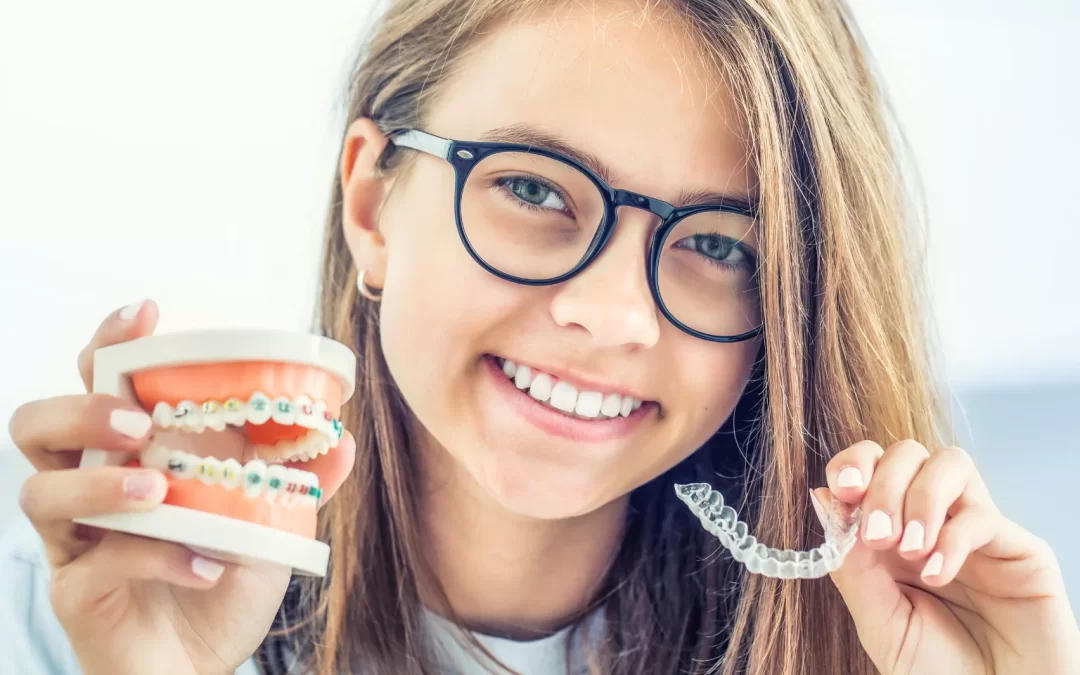
Invisalign and traditional braces are not competing versions of the same treatment—they are different mechanical systems for achieving tooth movement, each optimized for different levels of complexity, compliance, and control.
The key misconception is assuming one is universally “better.” In reality, the correct choice depends on case complexity, patient compliance, and how much control is required over tooth movement.
Once these variables are understood, the decision stops being subjective and becomes a structured suitability match between treatment method and orthodontic need.
Table of Contents
- Core Difference: Invisalign vs Braces
- Effectiveness and Case Complexity
- Treatment Time Comparison
- Cost Breakdown
- Comfort and Daily Life Impact
- Compliance and Discipline Factor
- How to Choose the Right Option
- FAQ
- Key Takeaways
Core Difference: Invisalign vs Braces
Braces use fixed brackets and wires to apply continuous mechanical force, while Invisalign uses removable aligner trays that apply controlled incremental pressure.
- Braces: fixed system, continuous force, clinician-controlled adjustments
- Invisalign:
The fundamental difference is control: braces maximize clinical control, while Invisalign shifts part of the control responsibility to the patient.
Effectiveness and Case Complexity
Both treatments are effective, but their suitability depends on orthodontic complexity.
- Braces: more effective for severe crowding, bite correction, and complex tooth rotations
- Invisalign:
In complex cases, braces typically provide more predictable movement because force is continuous and fully controlled by the orthodontist.
Treatment Time Comparison
Treatment duration varies based on case severity and compliance consistency.
- Braces:
- Invisalign:
Invisalign can be faster in simple cases, but only when wear-time compliance is consistent.
Cost Breakdown
Costs overlap significantly depending on provider, complexity, and geographic region.
- Braces:
- Invisalign:
The primary cost driver is not the appliance—it is case complexity and treatment duration.
Comfort and Daily Life Impact
- Braces:
- Invisalign:
However, removability also introduces a behavioral dependency that directly affects results.
Compliance and Discipline Factor
Compliance is the defining variable in Invisalign success.
- Invisalign requires ~20–22 hours of daily wear
- Missed wear time slows or reverses progress
- Braces eliminate compliance variability by being fixed
This makes Invisalign a hybrid medical-behavior system, while braces remain a fully clinician-controlled system.
How to Choose the Right Option
The decision is based on structural suitability rather than preference alone:
- Choose braces if the case is complex, requires precise control, or compliance is uncertain
- Choose Invisalign if the case is mild to moderate and consistent wear is realistic
The correct choice is the one that matches treatment mechanics to case complexity—not the one that looks more convenient.
In most borderline cases, orthodontists prioritize predictability over convenience.
FAQ
Is Invisalign better than braces?
Not universally. Invisalign is better for convenience and mild cases; braces are better for complex movement control.
Which works faster?
Invisalign may be faster in simple cases with strong compliance; braces are more consistent across complex cases.
Are braces cheaper than Invisalign?
Often yes, but cost depends more on case complexity than the appliance itself.
Which is more effective?
Effectiveness depends on the type of tooth movement required, not the system alone.
Key Takeaways
Invisalign and braces are not better or worse in absolute terms—they are different control systems designed for different orthodontic conditions.
The deciding factor is not preference, but whether your case requires maximum clinical control (braces) or allows compliance-dependent alignment (Invisalign).

Dr. Carter is a dental content contributor who focuses on explaining dental procedures, costs, and treatment options in clear, patient-friendly terms. His work is designed to help readers understand what to expect and how to make informed decisions about their oral health.
Content on DentalServices.us is created for educational purposes and is based on current dental guidelines and publicly available information. It is not a substitute for professional dental advice, diagnosis, or treatment.